Let's end Casteism on Teachers' day
Posted on Sat 05 September 2026 in Society
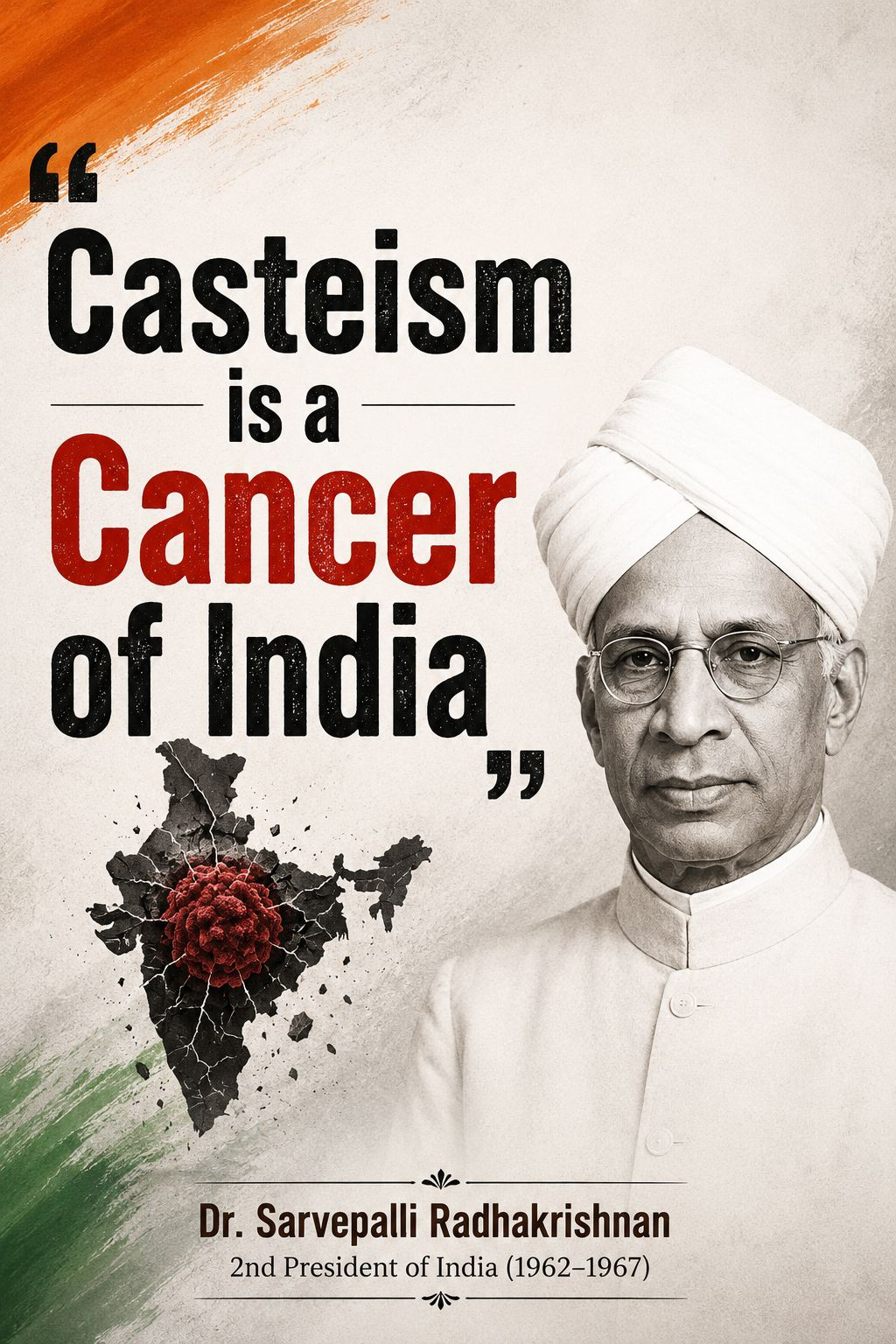
September 5th is Teachers' Day, marking the birthday of Dr. Sarvepalli Radhakrishnan — philosopher, statesman, and India's second President. He once described casteism as a cancer afflicting India. In that spirit, this piece revisits his views on the subject and asks that we treat Teachers' Day as an occasion to confront India's foremost social ailment.
Five Aspects of Radhakrishnan's Views on Casteism
1. Distinguishing Varna from Jati Radhakrishnan drew a sharp line between the original varna system, which he read as a classification rooted in guna — innate qualities, aptitude, and temperament — and the later jati system, which hardened into rigid heredity. He held that the ancient varna concept was meant to be fluid and function-based rather than birth-based, and that its calcification into hereditary caste was a historical corruption of Hindu social ideals.
2. Opposition to Untouchability He was unequivocally against untouchability and the discrimination it carried. He saw it as a moral stain on Hindu civilization and backed its abolition, believing, like many reformers of his era, that spiritual Hinduism had to be cleansed of such social hierarchies.
3. Philosophical Hinduism over Ritual Hierarchy Radhakrishnan consistently foregrounded the philosophical and mystical dimensions of Hinduism — the Upanishads, Vedanta, and the Gita — over ritual, priestcraft, and social rank. For him, the true essence of Hinduism was spiritual universalism, not caste orthodoxy.
4. Reformist, Not Revolutionary He was a moderate reformer rather than a radical social revolutionary in the mould of B.R. Ambedkar. Though he criticized caste and supported reform, he worked largely within a reinterpreted Hinduism rather than calling for its wholesale dismantling, favouring education and spiritual renewal over political agitation.
5. In Practice As Vice-President and later President, he upheld the constitutional values of equality and non-discrimination. His personal life and public positions reflected a cosmopolitan, caste-transcending outlook.
In Summary
Radhakrishnan opposed casteism, untouchability, and birth-based hierarchy, viewing them as deviations from Hinduism's true philosophical spirit. His approach was that of a scholar-reformer seeking to restore an idealized, merit-based social vision — not that of a revolutionary bent on destroying the system outright.
As Radhakrishnan dreamed of killing Casteism, let's end Casteism in India. Let the Modern India start with us!